You spent good money on the pool. You spent even more on the hot tub. And then you stopped short of the last five percent of the project, which is what actually makes the space feel like somewhere you want to be.
That last five percent is the landscaping. The plants that soften the edges of a concrete deck. The lighting that turns a summer evening into something that feels vaguely European. The seating that makes people linger. The privacy screen that lets you actually relax without wondering what the neighbors can see.
Almost every pool and hot tub owner underestimates how much this final layer changes the experience. You can install the most beautiful spa in the state of New York or North Carolina, and if the space around it looks like a construction site with a pool in it, you’ll never quite love the way you use it.
This guide covers seven landscaping approaches that consistently transform pool and hot tub areas into the kind of backyard people don’t want to leave. Each one works on its own. Together, they turn a functional pool deck into a real retreat.
Why Landscaping Around a Pool or Hot Tub Actually Matters
The pool or hot tub is the anchor. The landscaping is what makes the anchor feel like it belongs.
A well-landscaped setup does three things. It gives you the privacy to actually use the space without an audience. It extends the beauty of the water into the entire yard rather than leaving it as an island of concrete. And it makes the whole area photograph better, which matters at resale and matters to your own sense of pride in the space.
The projects below range from a single weekend of work to multi-season transformations. Start with the one that solves your biggest current problem and build from there.
Layer Plants for Privacy and Instant Beauty
The most common complaint from new pool and hot tub owners is that they feel exposed. Neighbors two houses down can see the whole setup. The back kitchen window looks straight onto the deck. A well-placed hedge or planting bed solves the problem in a single season.
The classics work for a reason. A boxwood hedge gives you a clean, formal look and privacy that fills in over two to three years. A row of evergreens (arborvitae, cedar, or juniper depending on your climate) grows faster and provides taller privacy for elevated properties or two-story neighbors. Bamboo works beautifully in Charlotte and warmer parts of the country but struggles through Buffalo winters unless you choose a hardy variety and give it protected placement.
For a softer, less structured look, layer ornamental grasses (miscanthus, feather reed, pampas in warmer zones) with mid-height flowering shrubs. The combination gives you privacy that moves in the breeze and changes with the seasons, rather than a flat green wall.
The rule of thumb: plant your privacy layer at the property line first, then work inward with progressively shorter plants toward the pool or hot tub. This creates depth and makes small yards feel bigger.
Choose the Right Plants for Your Climate
The plant choices that photograph well in Southern Living rarely translate to the reality of your yard. Charlotte and Buffalo require completely different plant strategies, and getting the choice wrong is one of the fastest ways to waste money on landscaping.
For pool and hot tub surrounds specifically, look for plants that handle splash from chlorinated water, tolerate the microclimate created by warm water and hardscape, and stay attractive across multiple seasons.
For sunny areas around pools:
Ornamental grasses, coneflowers, black-eyed Susans, coreopsis, sedum, lavender, and rosemary all handle heat and sun well. In Charlotte and warmer climates, add palms, elephant ear plants, and hibiscus for tropical feel.
For shaded areas or the shady side of a hot tub:
Hostas, ferns, coral bells, astilbe, and Japanese forest grass work in most climates. Coleus adds color and works as an annual in cooler zones or a perennial in warm ones.
For Buffalo specifically:
Stick with hardy zone 5 and 6 plants. Boxwood, arborvitae, hydrangea, coneflower, sedum, ornamental grasses, and Japanese maples all handle WNY winters. Skip the tropical look and lean into a Northern garden aesthetic.
For Charlotte specifically:
Zone 7 and 8 opens up palms, camellias, gardenias, southern magnolia, and tropical flowering plants. The longer growing season also means you get more bloom cycles from perennials.
The mistake most homeowners make is buying plants without knowing what zone their yard sits in. Look it up before you shop. A $200 plant that dies in one winter is a bad deal.
Light the Space for Evening Use
The single fastest transformation you can make around a pool or hot tub is the lighting. Adding proper lighting doubles the hours you’ll use the space and completely changes how it feels after dark.
Three types of lighting work together for the best effect.
Ambient lighting provides the overall glow. Weatherproof string lights hung from nearby trees, deck railings, pergolas, gazebos, or the wall of the house are the easiest and most affordable option. You can hang them in straight lines or create custom patterns based on your space. Café-style bulbs give you a warm, restaurant-patio feel that ages well.
Path lighting marks walkways and steps around the pool or hot tub. Low-voltage LED fixtures placed along the edge of pool decks, walkways, and hot tub access paths keep the space safe after dark and add subtle drama. Modern kits are homeowner-installable in an afternoon.
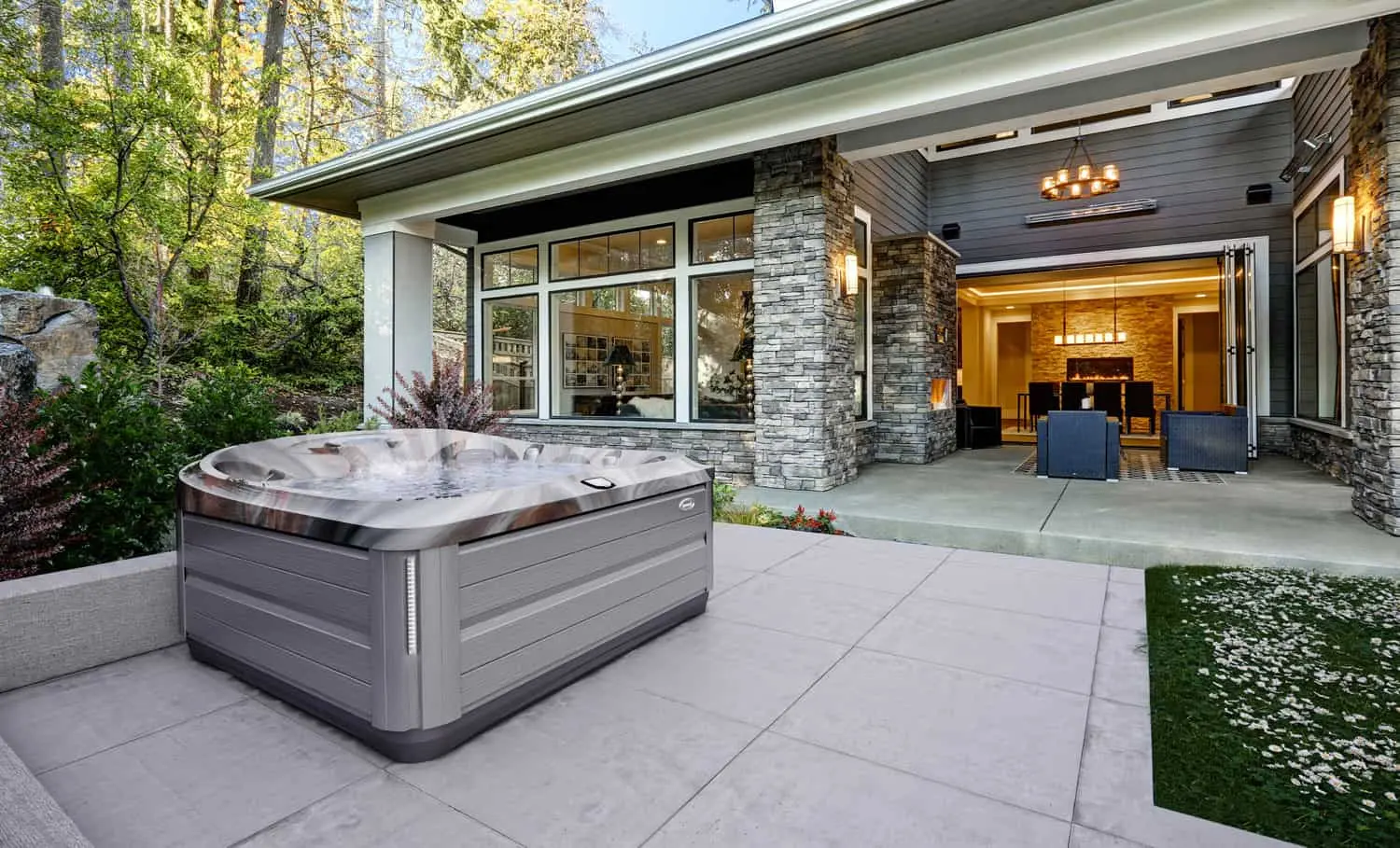
Pool and hot tub specific lighting goes inside or on the water itself. Above-ground pools can be enhanced with fiber optic lighting, floating LED lights, or wall-mounted spa lights. Most modern hot tubs from the Jacuzzi® lineup already include multi-color LED lighting inside the tub, so additional interior lighting usually isn’t needed. Instead, focus on landscape lighting that draws attention to the hot tub area and highlights the plants around it.
The best-lit pool and hot tub areas layer all three types. Ambient glow overhead. Path lighting at ground level. Accent lighting on the water or key architectural features. Add dimmer switches wherever possible so you can adjust for the mood and the season.
Add Hardscaping That Pulls the Design Together
Concrete deck alone reads as functional. Concrete deck plus intentional hardscaping reads as designed.
The easiest hardscaping upgrade for existing pool and hot tub areas is a paver pattern that extends the deck visually into the yard. Stone or concrete pavers placed in the lawn (with grass growing between them) create a checkerboard effect that softens the transition from pool deck to yard. Position them along a string line spaced 18 to 24 inches apart, dig out the grass to fit each paver, and secure them with a bed of sand or mortar.
The result: the pool or hot tub no longer feels stranded on an island of concrete. The design flows outward into the rest of the yard.
Other hardscaping ideas that work well:
- Stone or brick edging around planting beds
- A separate stone patio for outdoor dining or a fire pit, connected to the pool deck with a paver walkway
- Retaining walls that create planting terraces on sloped properties
- Decorative gravel or crushed stone paths connecting different zones of the yard
- Natural stone stepping stones through the lawn
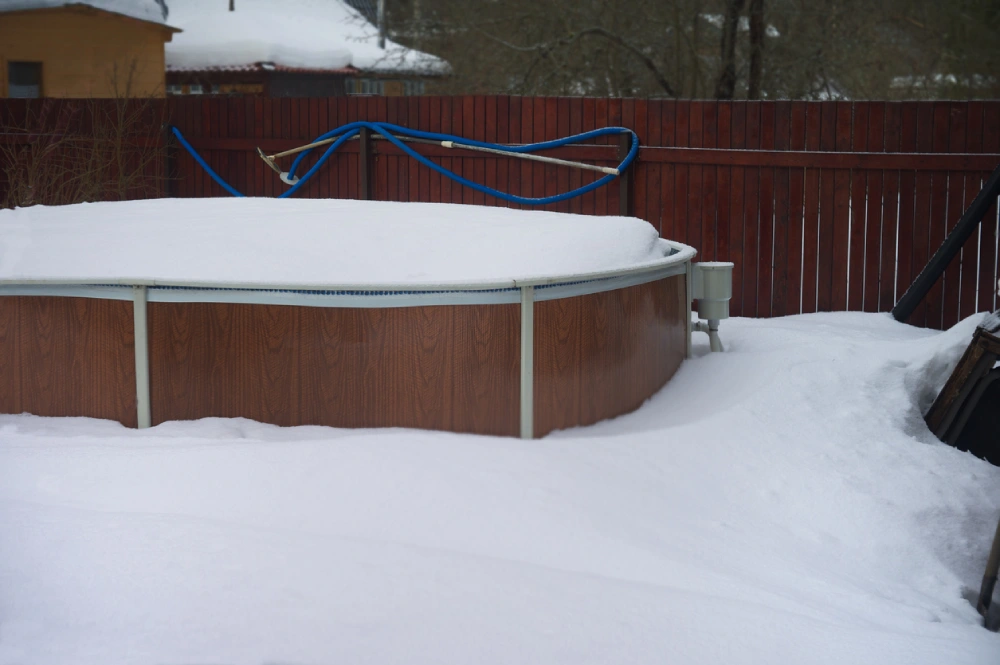
For above-ground pools from Carvin or Vogue, a wraparound deck plus surrounding pavers or a stone patio can turn what looks like a standalone pool into a real integrated outdoor room.
Create Seating Zones Around the Water
The space around the pool and hot tub should have somewhere to sit that isn’t just poolside lounge chairs. Multiple seating zones give guests options, keep people from crowding one spot, and turn the yard into a full outdoor living space rather than a swimming zone with chairs.
The three seating zones that work best:
Poolside lounging. Real chaise lounges with proper cushions, not the folding ones that break after two seasons. Position them for the best sun exposure and view of the water.
Conversation zone. A group of outdoor lounge chairs or a small sectional around a coffee table, positioned close enough to the pool or hot tub to be part of the action but far enough to have an actual conversation. This is where guests end up when they’re not in the water.
Dining zone. A proper outdoor dining table with real chairs, ideally under a pergola, gazebo, or umbrella for shade. If you host meals outdoors, this becomes the most-used part of the entire yard from May through September.
Furniture matters here. Cheap outdoor furniture doesn’t survive real pool use. Chlorine splash, sunscreen, wet swimsuits, and full-sun exposure destroy anything not built for it. The showroom teams at any of our locations carry outdoor furniture from Woodard, Telescope Casual, and American Heritage, all of which build lines specifically designed for pool and hot tub environments. Powder-coated aluminum frames, quick-dry cushions, and marine-grade fabrics hold up where box-store furniture doesn’t.
If you already have outdoor furniture that just looks tired, sometimes new cushions and pillows are enough. A set of fresh Sunbrella cushions transforms an aging frame for a fraction of the cost of replacing everything.
Add a Water Feature to Elevate the Setting
A separate water feature next to the pool or hot tub sounds redundant until you experience it. The sound of moving water changes the entire atmosphere. It masks neighborhood noise, adds a sensory layer that makes the space feel like a resort, and creates visual interest even when the pool and hot tub aren’t in use.
Options range from small to major:
- Small. A tabletop fountain or self-contained pot fountain on the patio
- Medium. A wall-mounted fountain against the house, garage wall, or a privacy fence
- Larger. A dedicated garden fountain with a stone or pottery basin, placed as a focal point in a planting bed
- Full commit. A waterfall or stream feature integrated into landscaping, often built with natural stone
For pool owners specifically, in-pool waterfalls or spillover features from a raised hot tub into the pool below create the resort look most homeowners are actually chasing. These require professional installation but transform the entire property.
Add Climbing Plants and Vines for Softness
The last layer that finishes a pool and hot tub area is vertical. Creeping plants, climbing vines, and pergola-mounted climbers add a lushness that flat plantings can’t reproduce.
The classics work well here. Climbing roses on a trellis or arbor, wisteria on a pergola (Charlotte only, it dies in Buffalo winters), clematis on a fence or lattice, or grape vines on an overhead structure. For a hot tub tucked against a privacy wall, a climbing hydrangea or Boston ivy softens the hard surface and creates a natural retreat vibe.
For lower spots, groundcovers like creeping thyme (which releases scent when walked on), sedum, or creeping jenny fill in bare soil around stepping stones and pool coping. They’re low-maintenance, look intentional, and eliminate weed problems in awkward transition zones.
The visual effect of climbing plants and groundcovers is what turns a nice pool deck into something that photographs like a magazine spread.
Mistakes to Avoid
The failures we see repeatedly around pool and hot tub landscaping:
- Planting too close to the water. Root systems near pools can damage liners and structures. Keep major plantings at least three feet from the pool edge.
- Choosing plants that shed heavily. Leaves, needles, and flower petals clog pool filters and skimmers. Avoid heavy-shedding trees directly over the water.
- Under-investing in privacy. The number one reason hot tub owners stop using their tubs is because they feel exposed. Handle privacy in year one, not year three.
- Overplanting. More plants isn’t better. Concentrated planting beds with breathing room around them look better than crowded coverage.
- Skipping the lighting. A perfect landscape at 3 PM is invisible at 9 PM. Light the space or lose half the use.
- Forgetting about winter. In Buffalo, evergreens carry the visual weight through winter. All-deciduous plantings turn into sticks from November through April.
Frequently Asked Questions
How much does landscaping around a pool or hot tub cost?
A basic DIY refresh with plants, mulch, and some path lights runs $500 to $2,000. Mid-range projects with hardscaping, professional plant installation, and landscape lighting run $3,000 to $10,000. Full custom landscape design with water features, hardscaping, and mature plantings can run $15,000 to $50,000 or more.
What plants shouldn’t I put near a pool?
Avoid heavy shedders (pines, oaks, magnolias), plants with aggressive root systems (bamboo running varieties, willows), thorny plants near foot traffic (roses without proper placement, blackberries), and anything toxic to pets or kids (oleander, foxglove, castor bean).
Can I landscape around an above-ground pool?
Absolutely, and it’s often the highest-impact upgrade you can make. Layered plantings around the pool’s perimeter, a wraparound deck, and a paver patio surrounding the setup can make an above-ground pool feel just as integrated as an inground one at a fraction of the cost.
How far should plants be from a hot tub?
Keep major plantings at least three feet away for maintenance access. Avoid plants that shed heavily directly above the tub. Small potted plants and container gardens can be placed closer as accents.
When’s the best time to landscape around a pool or hot tub?
Fall and early spring for plant installation. Summer for hardscaping work if you can access the space without pool use. Winter for planning and design decisions with a landscape designer.
Should I hire a professional or do it myself?
Basic plantings and lighting are homeowner-friendly weekend projects. Hardscaping (pavers, retaining walls, patios) and water features usually benefit from professional installation. If you’re spending over $5,000, a landscape designer often pays for themselves by preventing expensive mistakes.
How do I keep pool landscaping looking good long-term?
Mulch beds annually, prune shrubs and grasses each spring, refresh cushions and outdoor fabric every 2 to 3 years, and replace burned-out landscape lighting promptly. A quick weekly walkthrough during the growing season catches problems early.
Bringing It Together
You don’t have to do everything on this list to transform the space around your pool or hot tub. Most homeowners we work with start with two or three ideas, live with the results for a season, and add layers over time.
If your biggest current pain point is privacy, start there. If you never use the space at night, start with lighting. If the whole area feels stark and unfinished, start with plants. The right first move depends on what’s frustrating you most about the current setup.
Whatever you start with, the goal is the same. Turn the area around your investment into somewhere you actually want to be. Not a functional pool with concrete around it, but a real backyard retreat that pulls you outside from spring through fall (and year-round if you’ve got a hot tub in the mix).
See the pieces in person. Visit any Gary Pools & Leisure showroom to see the current Jacuzzi® hot tub lineup, above-ground pools from Carvin and Vogue, outdoor furniture from Woodard, Telescope Casual, and American Heritage, and everything else that goes into a well-designed pool and hot tub area. Our team can walk through your yard photos and help you plan the setup that works for your space, your climate, and your budget.
Locations: Amherst, Cheektowaga, Clarence (NY) and Matthews (Charlotte NC).